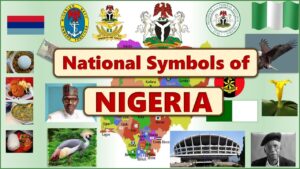
Nigeria’s national symbols hold great significance as they represent the country’s identity, culture, and values. These symbols were carefully chosen to reflect the aspirations of the nation as it gained independence in 1960. Let’s explore the story behind some of Nigeria’s key national symbols, including the flag, coat of arms, national anthem, and pledge.
1. The Nigerian Flag
The Nigerian flag, one of the most recognizable national symbols, was designed by Michael Taiwo Akinkunmi in 1959. The flag consists of three vertical stripes: two green stripes on either side, with a white stripe in the middle.
- Green symbolizes Nigeria’s rich agricultural wealth and natural resources.
- White represents peace and unity among the people.
Akinkunmi, a 23-year-old student at the time, submitted his design during a national competition. His simple yet meaningful design was selected and became Nigeria’s official flag when the country gained independence on October 1, 1960.
2. The Coat of Arms
The Nigerian Coat of Arms, adopted in 1960, is full of symbolism reflecting the country’s heritage and diversity. It consists of a black shield with a white Y-shaped band, two supporting horses, a red eagle on top, and other elements.
- Black Shield: Stands for Nigeria’s fertile soil.
- Y-shaped Band: Represents the confluence of the Niger and Benue rivers, symbolizing the unity of the nation.
- White Horses: Signify dignity.
- Red Eagle: Symbolizes strength.
- Green and White Wreath: Represents the agricultural wealth of the country.
- Yellow Flowers (Costus Spectabilis): The national flower, symbolizing beauty and the potential of Nigeria.
At the bottom of the Coat of Arms is the country’s motto: “Unity and Faith, Peace and Progress.”
3. The National Anthem
Nigeria’s first national anthem, “Nigeria, We Hail Thee,” was composed by British expatriate Lillian Jean Williams in 1960. However, it was later replaced in 1978 by the current anthem, “Arise, O Compatriots.” This new anthem was a product of a national contest, and its lyrics were written by five Nigerians, including John A. Ilechukwu, Eme Etim Akpan, and P.O. Aderibigbe. The music was composed by the Nigerian Police Band under the leadership of Benedict E. Odiase.
The anthem calls for national unity, service, and loyalty to the nation. It also emphasizes the need for citizens to contribute to Nigeria’s progress.
"Give thanks to the Lord for He is good: His love endures forever."
4. The National Pledge
Nigeria’s national pledge, recited by citizens to show their loyalty to the country, was written by Professor Felicia Adebola Adedoyin in 1976. It was introduced after the government recognized the need for a formal pledge to instill patriotism, especially among young Nigerians. The pledge is often recited during school assemblies and at public events.
The pledge reads: “I pledge to Nigeria my country, to be faithful, loyal, and honest, to serve Nigeria with all my strength, to defend her unity, and uphold her honor and glory. So help me God.”
This pledge reflects the desire for integrity, unity, and service among Nigerian citizens.
Conclusion
Nigeria’s national symbols, from the flag to the coat of arms, anthem, and pledge, are more than just representations of the nation. They embody Nigeria’s values, history, and collective aspirations. Understanding the stories behind these symbols deepens the appreciation for the country’s rich heritage and its vision for unity and progress.
